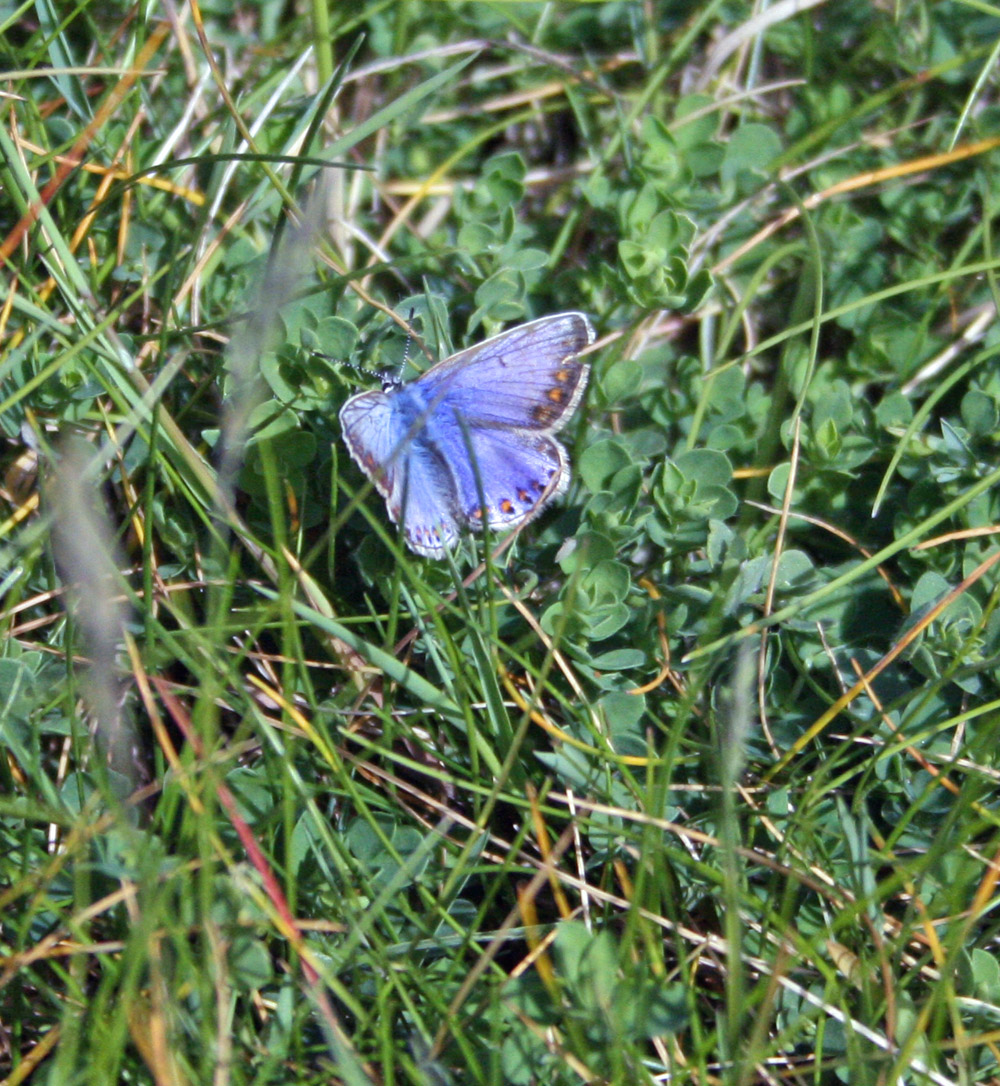
To say this butterfly is common is often only one step away from ignoring it. So this Blog is simply paying a tribute to the evolutionary process which has resulted in a most amazing small insect. The patterning on the under side of its wing is fabulous. This particular specimen happened to come to rest in the late afternoon today on a lavender bush. It wasn't feeding and it just sat there in the late sun whilst I got my camera together . A tripod to minimise hand shake and a 90 mm Macro lens and also a remote button for extra measure. I even had time to experiment with auto, AV and auto macro. The best results with the sharpest and clearest image was definitely using the tripod and macro lens. Click on the picture to see a larger image. Can you tell which one used a 50mm standard lens and which used a macro 90 mm lens and tripod and remote control? Both images are shown with a reduced file size for faster uploading.
Its definitely raining. We've been longing for rain to keep the garden growing and to encourage the orchids in our meadow for some time now. We hope it will produce a visually exciting spectacle for visitors. Today I'm spending time uploading some photos and revising my "to do" list. Yesterday with the help of the family offering advice and better still some with hard work, we were able to complete the construction of a new small pond in our "wild patch" and fill it with rain water for the first time. Its about three metres by two and 35 cm deep at one end. We emptied three water butts in doing so but this morning the rain is quickly refilling them. A small ceremony has just taken place in the rain with photographs of us adding some pond weed.
The photo's I'm showing you below were taken during a visit on 29th May to the Avalon Marshes visitor centre in Somerset. The occasion was the Avalon 24hr nature watch. Amazingly 12 hardy watchers received a certificate to confirm that they had indeed watched through the night. Owls and bats and moths at night and otters and various activities during the day.
I took a friend from Buckinghamshire along to see what was going on and we managed to do a quick tour of the Centre itself and three adjacent nature reserves. I think he was impressed by the peace and tranquility of walks on the reserves and the extent of the organisation going in to the extensive conservation work demonstrated.
The photos are just snaps really of items of interest ( to me at least)
This is an impressive set of wood carvings to symbolise the well known local feature of the Starling display each winter as they come in thousands to roost at night.
I thought this was an odd form of Tufted Vetch ( Vicia cracca) until I got closer and then realised the stem was covered in aphids (I assume) . They were all the same colour as the flowers which were missing. Is that because they were feeding on the plant? There were plenty of plants with flowers which are very attractive.
Natural England were playing a big part in running the 24 hour event with tractor rides around the nearby reserve.
Goats-beard, sometimes called Jack-go-to-bed-at-noon (Tragopogon pratensia ) is really impressive growing on the banks of a Rhyne. ( Somerset name for a drainage ditch)
Caterpillars in large numbers may not be everyones "cup of tea" but here they show the way they start their lives as moths or butterflies. Can someone tell me which and name them ?
Benches are placed around these very quiet reserves, rarely disturbed by planes or traffic noise. Sitting watching the fish coming to the surface now and again was a very impressive and satisfying experience for my guest and myself.
John is Chair of the RPS Nature Group and recently gave his time to run a wildlife photographic workshop for us.
For nature watchers I can report seeing the first Marbled White on our reserve yesterday. Also saw a Hummingbird Hawk Moth about 11 am in a local lane.
George has made some interesting comments on the National Ecosystem Assessment referred to in my last post. I recommend your read the whole article in the Guardian newspaper. Here are a few quotes to wet your appetite.
The well-intentioned dolts putting a price on nature are delivering it into the hands of business.
By George Monbiot. Published in the Guardian 7th June 2011
"Under the last government, the Department for Transport announced that it had discovered “the real value of time”. Here’s the surreal sentence in which this bombshell was dropped: “Forecast growth in the real value of time is shown in Table 3.”
Last week the Department for Environment announced the results of its National Ecosystem Assessment, a massive exercise involving 500 experts. The assessment, it tells us, establishes “the true value of nature … for the very first time.”(2) If you thought the true value of nature was the wonder and delight it invoked, you’re wrong."
"How do they calculate these values? The report tells us that the “ecosystem services” it assesses include “recreation, health and solace”, and natural spaces “in which our culture finds its roots and sense of place”"
"Cost-benefit analysis is systematically rigged in favour of business. Take, for example, the decision-making process for transport infrastructure. The last government developed an appraisal method which almost guaranteed that new roads, railways and runways would be built, regardless of the damage they might do or the paltry benefits they might deliver(8). The method costs people’s time according to how much they earn, and uses this cost to create a value for the development. So, for example, it says the market price of an hour spent travelling in a taxi is £45, but the price of an hour spent travelling by bicycle is just £17, because cyclists tend to be poorer than taxi passengers"
"Its assumptions are utterly illogical. For example, commuters are deemed to use all the time saved by a new high speed rail link to get to work earlier, rather than to live further away. Rich rail passengers are expected to do no useful work on trains, but to twiddle their thumbs and stare vacantly out of the window throughout the journey. This costing system explains why successive governments want to invest in high-speed rail rather than cycle lanes, and why multi-billion pound road schemes which cut two minutes off your journey are deemed to offer value for money(10). None of this is accidental: the cost-benefit models governments use excite intense interest from business lobbyists. Civil servants with an eye on lucrative directorships in their retirement ensure that the decision-making process is rigged in favour of over-development."
I'm not sure I agree entirely with George. The whole subject needs some thought
Before getting onto the serious stuff. Can anyone identify this butterfly. Taken on the Island of Guernsey about 2 weeks ago?
Been following up on this new report which promises to generate a great deal of comment. As you can see below there is so much interest in it that the full report is not yet available and their web site is so busy you might have difficulty seeing even the Synthesis. This report should be a very useful tool for anyone campaigning for more action to support wildlife and to deal with our headlong rush towards climate change
This will take some time to assess.
**The UK NEA website is currently experiencing high traffic levels which is causing problems for some users wishing to download the Synthesis report and Technical Report chapters. We are aware of the problem and hoping to rectify it as soon as possible. Alternatively, a copy of the report has been made available temporarily on the Defra website:www.defra.gov.uk/environment/natural/uknea/**
Yesterday's photographic workshop was a great success. The 18 participants where all SWT members I believe, (although that wasn't a condition for attending), and all agreed that it was well organised and a good format for learning something new about taking better photograph's, especially of flowers . I'm hoping to collect a few of the best pictures so we can share them around.
Meanwhile I am showing here some of my efforts. What I learnt above everything else was that I need to learn a great deal more about my Cannon's capabilities so that I can make much more use of them. Thinking hard about the subject and how to position the camera , the depth of focus, the need for a better tripod than my present rather elementary one, and much else. So if you bear that in mind when you view my examples I would be grateful.( I'll add some identification details later and dont forget you can enlarge the photos by clicking on them once or twice)
Before reading on via the link here are three photos taken in our garden last week. After first identifying a red Cardinal Beetle ( Pyrochroa coccinia) I now think it was a Lily Beetle (Lilioceris lilii) and the seed case for a Winter Aconite.
Last Sunday we held a very successful and enjoyable walk in Beer Wood to check out the spring flowers.
To follow that we have organised a one day workshop on May 1st to help people improve their photography of plants.
The details are all on our Heart of the Levels Diary Blog. Linkhere
We have a limit of 20 people for the workshop and now have 15 paid up attendees. So hurry if you're interested. Below is a John Bebbington photograph of the Yellow Archangel flower. ( Lamiastrum galeobdolen )
If you read this news report on a UN report presented in London at the London School of Economics you may conclude that mass marches in London because of belt tightening by government or fighting in Libya are both pretty small fry in terms of the effects of our continued and growing pollution of our one and only atmosphere. Here is an extract:
Urban areas are set to become the battleground in the global effort to curb climate change, the UN has warned.
The assessment by UN-Habitat said that the world's cities were responsible for about 70% of emissions, yet only occupied 2% of the planet's land cover.
While cities were energy intensive, the study also said that effective urban planning could deliver huge savings.
The authors warned of a "deadly collision between climate change and urbanisation" if no action was taken.
The Global Report on Human Settlements 2011, Cities and Climate Change: Policy Directions, said its goal was to improve knowledge of how cities contribute to climate change, and what adaption measures are available.
Worrying trend
Joan Clos, executive director of UN-Habitat, said the global urbanisation trend was worrying as far as looking to curb emissions were concerned.
"We are seeing how urbanisation is growing - we have passed the threshold of 50% (of the world's population living in urban areas)," he told BBC News.
"There are no signs that we are going to diminish this path of growth, and we know that with urbanisation, energy consumption is higher.
According to UN data, an estimated 59% of the world's population will be living in urban areas by 2030.
Every year, the number of people who live in cities and town grows by 67 million each year - 91% of this figure is being added to urban populations in developing countries.
The main reasons why urban areas were energy intensive, the UN report observed, was a result of increased transport use, heating and cooling homes and offices, as well as economic activity to generate income.
The great news (11.04.11) is that Nicky completed the MDS in great style and with badly blistered feet and is now back home in Somerset. It was nerve racking following her progress on the MDS web site Over £1500 raised do far for her charity. You can catch up with videos of all of the 6 stages covering 151 miles of desert running on the MDS web site Clickhere for the link.
Original post below.
I'm showing this message on behalf of a friend who I sometimes run with in Somerset and who is about to fly to Morocco to run in the desert. I'll try to find out more about wildlife in the Sahara which Nicky might bump into! I hope the video works , see below.
Our Club has often donated money to local charities but this time it’s personal.
Three members of Langport Runners are training hard for three quite different challenges and all raising money for charities connected to our Army, Navy and Air Force.
Nicky has already appeared on the front page of the Western Gazette, been interviewed for half an hour on BBC Somerset Sound on Thursday 24th March ( listen again on iPlayer) and has a date lined up with Heart FM for Monday! She flies out to Morocco on Thursady 31th to prepare for the start of the race on 1st April. (That’s not a joke!!)
Nicky is running 151 miles across the Moroccan Sahara Desert, avoiding poisonous snakes, spiders and scorpions, coping with the heat and the sand, to raise money for a small charity set up by Sergeant Pen Farthing Royal Marines after his service in Afghanistan for stray and abandoned dogs and other animals in need of care in war zones in Afghanistan.
Love a challenge. Some reckon I have a death wish!! Have completed 27 sky dives, dived with sharks, done the highest commercial abseil in the world, bungee jumped, climbed Kilimanjaro, run the Inca Trail, lots of white water rafting including the Zambezi, cycled Lands End to John O Groats, completed 19 marathons, 6 ultra marathons & a mountain marathon! Whew! I'm exhausted thinking about it. Have a place for the 2011 MdS.
Official notice to supporters. Nicky’s Race Number is 702
Remember to tell your family, friends and sponsors that they can leave you messages during the MARATHON DES SABLES, but only from 24 to 30 March 2007. Go to the website and follow the instructions.
http://www.darbaroud.com section "écrire aux concurrents/write to competitors" After 30 MARCH, this email service will no longer be operational.
Only messages with surname, first name and race ID number will be transferred.
Do not send attachments (e.g. photos). This will cancel the message. Messages will be given to competitors on the bivouac every day.
Mel Munday, married to Richard serving in the Royal Navy, will be running her first marathon in London on April 17th to raise money for SSAFA,
Pete Jones was in the Royal Navy and a member of the crew of HMS Coventry when it was attacked and sunk whilst supporting the Falklands campaign. He will be completing the Forces March starting on 25th May by running 5 marathons in 5 days. Money raised will go to supporting serving, retired and related members of the armed forces including Help for Heroes.