Search This Blog

Showing posts with label Wildlife seen locally. Show all posts

Thursday, May 10, 2018

How can I record wildlife I see in my village?

On Tuesday this week our local group of the Somerset Wildlife Trust organised a talk to explain to members how we can do this.
I was interested to listen to an excellent presentation of the on line recording system developed by Somerset Environmental Records Centre.( SERC) I followed up the same evening by entering my sighting of a Orange Tip butterfly in my own garden two days ago. I expect many people have seen them recently. After a couple of tries I have entered this sighting onto the Somerset Records. Not remarkable but as was apparent from questions a common reaction to being urged to report common sightings is  why report something which is thought off as not worth the effort.

For me the reason is the same as led us to start our own local village system which you can see in operation if you visit Curry Rivel Community Website. Use this link :http://www.curryrivel.org.uk  A map is shown with the Parish boundary marked  using Google Earth maps and on the map are symbols to represent the reports we have receive, their location and description of what was seen. We set that system up because of our interest in wildlife and because as on of small group of volunteers said," if we want to protect out wildlife then we first need to know what wildlife is currently resident in our area!"

What I learnt form our talk was that SERC have given us the means to pass on our sightings so that they can be " officially" recorded centrally for Somerset where they are available for planning departments , developers and local councils who are considering housing and other projects.

So its a lot more than just local curiosity and interest and I hope we will be able to use this tool and well as keeping our local initiative going in parallel.

SERC web site and the way to make our reports are clearly shown at this web address link:   http://www.somerc.com/who-are-serc/

To see the Facebook page for our local area group of the Somerset Wildlife Trust try this link:http:://www.somersetwildlife.org/Heart_of_the_Level

Thursday, May 03, 2018

Curry Rivel wildlife

I posted this short report on our Community Web Site and have already had several new sightings so happy with that.

The Wildlife Survey Group has set up a map of the village and we add a marker every time someone reports any form of wildlife. 
To view the map simply click here 

To report your sighting if you use a mobile phone or other computer device email to: davidgerman555@gmail.com or editor@curryrivel.org.uk or curryrivelnews@gmail.com
It will reach me, David German, eventually!
At the recent Annual Parish Assembly I was able to report that the Wildlife Survey Group is indeed still alive and well and collecting news of fresh wildlife sightings around Curry Rivel.
Most of the reported sightings so far have been added with an approximate location to the Village Wildlife Map on the website.
Reports for 2018 include the following:
5.3.18.I was contacted about an unusually large "creepy crawly"
I've copied how I asked SERC for identification!
Sent to SERC:
"Help please!
What is this? Sent to me this morning. Found on a slab sunbathing yesterday in a garden next to Batty Piece. Looks very pale and seems to have a pair of legs per segment. I've checked the length and was told it was about 10 cm.It seems to be a centipede but rather big? Mobile phone picture included.The person sending this didn't actually see it and will contact the originator for more info if possible.
Regards,
David"
Response from SERC:
"Thank-you for the creepy crawly photo, it is indeed a centipede. As to which is not so easy to say, there are 57 species of centipede in the UK!
Here is an interesting link
The Western yellow centipede (Stigmatogaster subterranea) seems plausible, up to 70mm, not so long as your specimen but possible. The Nature Spot website says there are several very similar species and they can only be identified conclusively with an id key and a microscope, not from a photo sadly! So, centipede sp. is as good as we can get.
Actually, some people keep non-native centipede species as pets so it could even be an escapee." 
8.4.18 Video clip of two stoats fighting in a local ditch. Very dramatic and serious with probably only one winner! Will try to show video complete with sound effects!


Tried but not working!


Other reports in April so far include ,Swallows,House Martins, early purple wild orchids, Bluebells, primroses and Cowslips in East Field and Batty Piece in large numbers.
By coincidence there will be a Wildlife Trust public meeting with a presentation of the recording work by Somerset Environmental Centre organised by the Heart of the Levels Volunteer Group 8th May in Somerton.
"It is the endless task of the Somerset Environmental Records Centre (SERC) to record the county's plant and wildlife. Why is this so
important, and what is this information used for? Come and find out how you can make a big contribution to counting our wildlife."

Sunday, November 12, 2017

Curry Rivel Wildlife Survey Group report. Cranes on the Levels

I'll try to add the photo soon,


Curry Rivel News
A  West  Sedgemoor  Wonder
Photo attached
Timmy and Michaela with their two young hatched on West Sedgemoor in 2017.
Photo courtesy of John Crispin
This year, for the first time for in four centuries a very special event took place on the West Sedgemoor reserve–  five golden, fluffy chicks were hatched.  Three pairs of Eurasian (or Common) Cranes successfully reared four chicks to the point of fledging.  They, with their parents, are now with the general flock and can be seen at times within the bounds of Curry Rivel village.  The juvenile birds are almost as big as their parents now but they don’t quite look like them yet.  They have rusty coloured heads and necks unlike the adults who have black and white heads and necks with a bright red top to their heads.  The young stay with their parents for around a year until the breeding season starts and then they are chased away so that the adults can get on with their important breeding work.  Local schools and businesses were encouraged to champion the released birds so they all have pet names though they are properly identified by their leg rings.
The best place to observe a flock is from the Parrett Way between Oath and Stathe but they do move around quite a lot.  They can be seen in the air in their V shaped pattern and can be heard ‘bugling’ (a bit like yodelling).  The released birds still wear their coloured identity rings which are on their legs and this helps to record their progress.  Out on the Levels they are remarkably difficult to see considering they are now one of the largest wild birds in Britain.  Nature has ensured that they melt into the background whatever it is.  Also they love feeding in ditches and where the vegetation is tall.  However patience is rewarded by the sight of them peacefully feeding or preening.  It will be some years before the project is considered a success because Cranes are quite long lived (around 20 years) and take time to establish a sustainable flock.
The project to re-introduce cranes to the Somerset Levels, where they used to be very common until hunted out of existence, started in 2010.  After 5 years around 100 birds had been released after eggs from  Germany were hatched at WWT Slimbridge.   93 birds have survived and all are capable of breeding now.  So far these beautiful birds have produced 11 young  in locations as far away as Wiltshire and South Wales  but this year the successful rearing took place on West Sedgemoor – the event we were all waiting for!  This has confirmed the wisdom of releasing them on the Levels where hopefully they will stay for a long time to come.
If you would like further information you can visit the Crane website: 


Liz Antliff-Clark

RSPB Volunteer
and member of our CR Wildlife Survey Group.

Tuesday, August 08, 2017

Glow worm search


The Heart of the Levels Group had a successful search a few weeks ago and found 15 insects  near Somerton. This walk hopes to find the insects in Curry Rivel parish.


Curry Rivel News August 2017
Gleeful Glow worms in Curry Rivel Catherine Mowat
Family event Were looking for glow worms around Curry Rivel on Friday 11th August. Come and help us find them! Meet outside West Field play park at 8pm. Bring torches and stout footwear; children must be accompanied. We will split into groups, some walking a short distance on easy terrain, some further – up to 2 miles – who will explore steep uneven terrain. This will be in the dark, and people can choose their group.
As we travel in our cars at night with their glowing headlights, we fail to notce the little magical glow worm, shining about as bright as a hi-fi LED indicator. Yet we are fortunate to have these unusual beetles in our parish. The adult female has glowing segments on her tail; she sits in open grassland and holds up her tail after dusk to atract a mate. She cant fly, and repeats this for several nights until a male – who can fly – flies in and mates with her. She then turns out her light, lays her eggs and dies. She is called a glow worm because she looks a bit life a caterpillar, with segments and no wings. The eggs hatch into larvae which spend two summers or so, feeding on snails which they paralyse before sucking them empty.
If you find a glow worm, admire it but do not disturb it and, most importantly, leave it where it is. There are very few about indeed, we need to let them get on with their life. 

Thursday, June 09, 2016

Curry Rivel's Wild Life Survey


Since I posted this report on our web site some time ago we have decided to change the title to Curry Rivel Wildlife Survey just to keep things simple! Our objective is still the same!


Here is a post I have just put on our Curry Rivel Facebook page which describes our continuing efforts to find out about wildlife in our parish and protect it.


Curry Rivel's Natural Health Service
How healthy is Curry Rivel’s natural environment? What makes the village a good place to live? Our parish is blessed with amazing natural surroundings, with sites of county, national and even international significance, which make the village an interesting, stimulating and  relaxing place to live. We would like to find out more about what's around us, and we are inviting you to join in our search.
We are a group of villagers who are interested in the natural environment. We don’t have a group name yet, but here are some of the things that we would like to do:
·        Map what is around us
·        Provide information to help with responses to planning applications
·        Share our  local knowledge
And here are some of the ways that we will do that:
·        Put a map on the Curry Rivel website, showing where the interesting plants and animals are
·        Ask people in the village to use their eyes and ears to help
·        Explore links with the Somerset Wildlife Trust

We are starting by focussing on hedgehogs. Do they occur in our parish? Are they increasing/decreasing in number? Please help us start by sending details of any sightings, alive or dead, in Curry Rivel parish in June or  July, with the place and time, to David German, at: davidgerman555@gmail.com

Tuesday, January 05, 2016

Biodiversity

As you may recall I have been involved in helping to produce a Parish Plan for the Somerset Parish I live in.
A section of the plan is all about the countryside and wildlife in the 6 sq miles around Curry Rivel.
It includes part of the nationally important RSPB reserve called West Sedgemoor and other local nature reserves. For 2016 I hope we can capture some local enthusiasm for protecting / saving / rescuing biodiversity in our Parish.
Somerset Wildlife Trust has a big programme called Living Landscape but that is limited to several specific areas of the county. It would be great if we could add every parish to that programme by local volunteering action. Is that a practical reality or just a dream?

Please watch the video from Natural England


Friday, July 10, 2015

Batty Piece, Ladies Bedstraw and Humming-bird Hawk Moth

Since my last blog we have been away on holiday to Italy and seen some interesting wildflowers and butterflies , now back home I can add the latest news from our local meadow.

In my absence a friend visited our field and sent me these three photographs. His email comment was
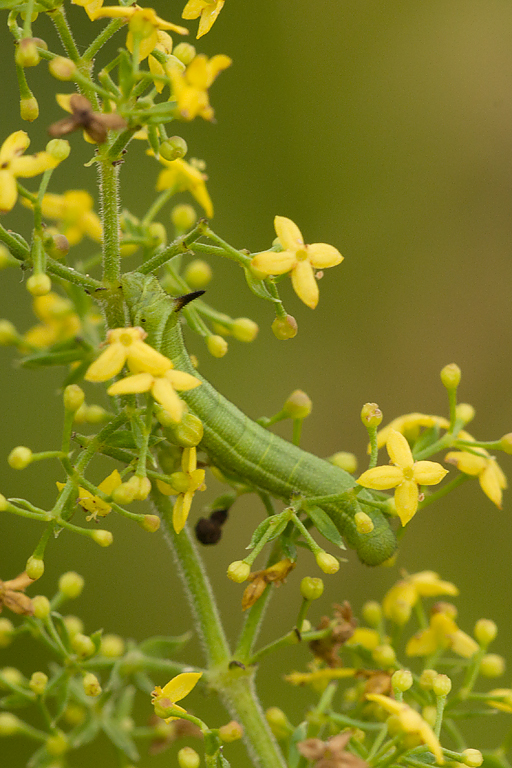
 "I found three Humming-bird Hawk-moth larvae on the Lady's Bedstraw in Batty
Piece this morning. There was also a Scorched Carpet moth by the gate. "   Not being a trained observer myself I find it hard to see such detail.
John Bebbington is the photographer and has publish a book you might find interesting and useful. Its title is  "Insect Photography -  Art and Techniques "   ISBN 978 1 84979 378 8.  Published in 2012 by The Crowood Press Ltd. 

I was very pleased to see today, in our garden around 200 m from the field, a very busy Hummingbird Hawk Moth feeding on some flowers. I've photographed them before but not virtually at the same time as seeing the larvae ( or caterpillars as I would say! )
The field itself I visited today and it is still full of pyramidal orchid in flower , knapweed, ladies bedstraw, field scabious and numerous butterflies including the marbled white.. I did however find again the seed capsule of the Bee orchid which finished flowering in June. Back in july I found several locations with Bee orchids including one small area with around 20 plants which I hadn't seen before. It was a delight to see the meadow looking so good in the bright sunshine.


Wednesday, June 24, 2015

Common Broomrape or Orobanche minor

Part 2 ( see my previous post for part 1)

At the other end of our garden is a small wild patch  where I try to encourage native plants and control strong growing grasses. Teasels are growing well there and whilst trying to help by removing some grasses at the base of a teasel plant I unfortunately found myself holding the flowering stem of a broomrape which I believe is the common species. Trying to identify it I cut in half one of the flowers and found the two purple stigmas joined on a single style and with 4 stamen which I think show up quite well in the photos. So I am fairly confident with the identification and will look to see if other specimens have survived my "weeding" ! These plants can be seen out in the fields nearby if the management allows! There is an obvious message in this post and the previous about the conflict between humans and plant life


Pyramidal Orchid and Common Broomrape OR Anacamptis pyramidalis and Orobanche minor

This is a tale about these two plants which have appeared in our garden this year. The orchid appeared last year also but not in the same spot in our front lawn. At times it's not so much a lawn as a nursery for plants that happen to choose to appear!
Earlier this year I cut the grass probably in March or April and kept my eyes open for anything that looked like an interesting plant. Then it was left to grow on until I gave it another cut and this time suddenly spotted a Pyramidal orchid plant just inches in front of the mower! I went round it and left a small path of grass and the orchid to grow on. A bit later as the orchid plant began to send up a flower spike I took a photo and took another just now. The first was on 28th May when the plant was about 19 cm high. You can see that the tips of the leaf has been clipped which I believe was made during the first mowing

The next two were taken today 24th June and the flower is nearly fully open and has grown to 32 cm.
The photos of the Broomrape I'll put in another post!


Sunday, June 21, 2015

Eastfield and Batty Piece


Just posted this on our local community web site Facebook page and it might be of wider interest!
Eastfield is a 4 acre field alongside our Batty Piece private nature reserve. I added the photos I have added to my previous Blog post.


A couple of days ago I walked round the edge of Eastfield looking at the narrow strip of uncut vegetation that the Council has excluded from the fortnightly mowing regime it introduced last summer. I was very delighted to find that the long established wild Pyramidal orchids are still surviving and are now in flower. I counted at least 50 specimens spread around all four sides. Obviously there are many other native plants that can be seen and it shows how the meadow could look if a larger are could be spared. It's not just plants that are benefiting, butterflies are there in large numbers, Meadow Browns and the Marbled White making use of the long grass. Insects of many types, food for the Swifts which we see now and so on to make up a rich biodiversity which even the Pope recognises as being our responsibility to protect. Please visit Eastfield and see for yourself.

Here are a few more photos from our meadow.


Saturday, June 20, 2015

Batty Piece

Our 4 acre wildlife meadow is at its best in June. Bee Orchids and Pyramidal Orchids are now well into the flowering season. I found around 30 or 40 Bee Orchids this week and the Pyramidal are too numerous to count. Grass Vetchling is spread around the field as is Yellow Rattle. Patches of Ladies Bedstraw are nearly in flower and I found a few Broomrape. Knapweed is coming into flower and Field Scabious. Butterflies are common including Marbled White.
I'll add a few photographs soon.


Friday, June 05, 2015

Day three of the Wildlife Trusts #30DaysWild Challenge

this evening about an hour or so ago I went for a jog and a walk round our local nature reserve 4 acre wildflower meadow, I'm pleased to say that I spotted two  very new Bee Orchids to add to the one I spotted two days ago and a freshly flowering Pyramidal Orchid. That is quite an achievement because we rarely see more that say a dozen bee orchids but hundreds of pyramidal and they may well be a bit later than the bee orchid. Also almost in flower is Ladies Bedstraw and Yellow rattle is flowering over much of the 4 acres. Knapweed is coming along but not in flower in our field but I noticed in an adjoining farmed field margin.Grass vetchling with its small brightly coloured purple flow is visible every where. Grasses are flowering so would make a very good identification exercise. We have found 15 different species of meadow grass and I saw tonight a patch of quaking grass.
So that is my contribution to the 30 day challenge and I'll have to keep looking for the rest of the month.

Here is a link to a blog written by Jane who has been blogging on wildlife for quite a time. She is also following the Wildlife Trust national challenge to record some contact with wildlife for 30 days and this is her 3rd dray post

Day 3: Running, owls and butterflies

Day three of the Wildlife Trusts #30DaysWild Challenge

Try this link to the Wildlife Trust web site:    http://www.mywildlife.org.uk/30dayswild/

Thursday, May 28, 2015

Local wildlife news, wild orchids

We haven't heard from our nightingale for a couple of weeks now. and we don't know what has happened to it.

Early this morning about 5am noticed a fox out in the nearby field. Looked as if he was trying to find some food, even chasing after birds on the ground but unsuccessful. The usual group of rabbits was nowhere to be seen.

Mowing our front lawn I was looking out for signs of wild orchids and just in time I spotted one. See photo below. We found one last year also but in a different location. You can see in the photo that its leaves have been cut a little. That must have happened when I did an early cut on the lawn. The flower spike is intact and should be opening as a pyramidal orchid soon.


Friday, April 24, 2015

Nightingale still singing every night.

The earliest local report this year of hearing a Nightingale singing at night here in Curry Rivel was Thursday 16th April. Maybe a single bird but it has been heard every night since and once in the morning in daylight. Just been listening from home at 2300 hrs.
As a summer visitor I am hoping to find out more about where it may have come from?
In its migration does it fly at night?
Now it's here why does it sing at night as well as in daylight?
Is it likely to be a male bird hoping to attract a female?

The planned walk being organised by our local Heart of the Levels Wildlife Area Group has had to be cancelled so maybe I can help out!

Tuesday, April 21, 2015

Nightingale update. Luscinia megarhynchos

Our night time walk was very successful and a rewarding experience. I was joined by one other neighbour and we easily located the singing bird at around 11 pm in the top branches of an old overgrown hedge, mainly Blackthorn.We didn't try to see it directly but it didn't take any notice of us within about 10 metres  away. It was singing again last night at midnight. Other local reports say it was first heard last thursday , 16th April.

Here is  some information from the RSPB web site. Next question: where did this bird spend the winter?


It seems that in the middle of Somerset we are on the normal western end of their summer visits.


Luscinia megarhynchos


Where to see them

A secretive bird which likes nothing better than hiding in the middle of an impenetrable bush or thicket. In the UK they breed mostly south of the Severn-Wash line and east from Dorset to Kent. The highest densities are found in the south east: Essex, Suffolk, Norfolk, Kent and Sussex.

When to see them

They arrive in April and sing until late May and early June. They leave again from July to September. They can be heard singing throughout the day, as well as at night.

What they eat

Insects

Population

EuropeUK breeding*UK wintering*UK passage*
-6,700 males--

Wednesday, November 13, 2013

South Somerset Climate Action Group

Before getting to something more serious I've just selected this photo I took in our garden some time ago to remind me why I keep making these posts on anything which effects the countryside around me.
Not the best wildlife photo but good enough to illustrate my point! A butterfly described as scarce in England so I was lucky to see it and have a camera nearby!

Brown Hairstreak,    Thecla betulae


I've just been reading an email from Joe Burlington who runs the South Somerset Climate Action  Group. Its been running for several years now and does really effective work to spread the word about Climate Change and Global Heating.

You may find his blog interesting and the groups current programme of event,talks and discussions.

Here is a link:http://  www.southsomersetclimateaction.org.uk/about/

I'll Post some more information soon.

Here is an extract from the email:

"Tuesday 26 November - Will your solar pv keep your lights on in a power cut? Yes, but ...5.30 for 6pm. End at 7.30 discussion may continue until 8pm.  Suggested donation £3 (includes refreshments)
Jon Lewes, Coordinator, LocalGen Home Energy Centre, 8 Ditton Street, Ilminster, Somerset TA19 0BQ. Parking available round the corner. t.   01460 250986  m. 0751 8039458, www.localgen.org.uk 

Later on Tuesday 26 November: CLIMATE UPDATE: Dr Stephan Harrison of University of Exeter “MAKING SENSE OF: Floods in Summer - Floods of Information - Floods of Uninformed Debate” The Williams Hall, Stoke St Gregory TA3 6EU .  8.15 Doors open for refreshments at 7.50pm .. after Transtion Athelney’s AGM which starts at 7.30.
Stephan will be looking at: certainty, uncertainty and probability; the difference between climate and weather (Was flooding on the Somerset Levels last Summer ‘caused by’ climate change?); recent developments; how complex science is communicated; land surface warming compared with increased energy in the climate system, which intensifies extremes.

Views:  Monbiot in the Guardian – Ken Clarke’s response – Quakers - Joe Burlington
……………."


And Joe ends with this comment:  

"My anger? The government and energy companies refer to ‘green subsidies’ - as though they were deplorable - rather than a feeble but necessary step in the right direction. At the same time, the fossil fuel industry is receiving tax breaks and other financial benefits that are extensive and are being increased. I have asked our MP for details. I await his response!"

Joe has been campaigning for a long time to increase awareness about all these related issues and is clearly very frustrated!