Search This Blog

Showing posts with label Moths. Show all posts

Friday, July 10, 2015

Batty Piece, Ladies Bedstraw and Humming-bird Hawk Moth

Since my last blog we have been away on holiday to Italy and seen some interesting wildflowers and butterflies , now back home I can add the latest news from our local meadow.

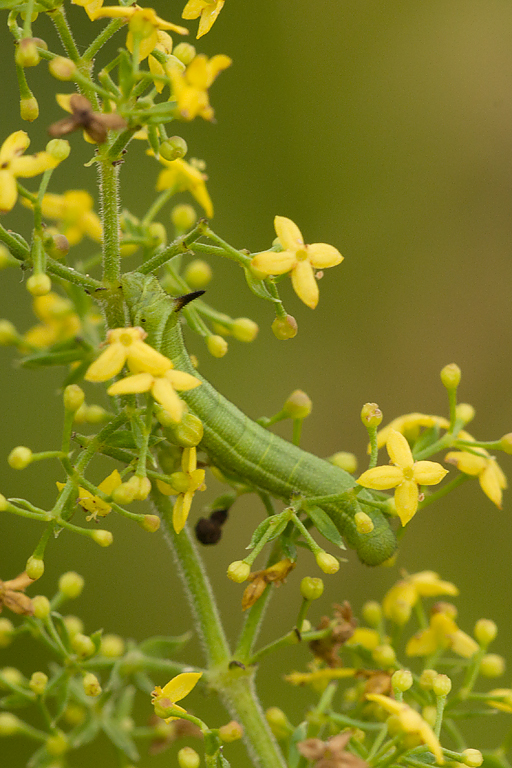
In my absence a friend visited our field and sent me these three photographs. His email comment was
 "I found three Humming-bird Hawk-moth larvae on the Lady's Bedstraw in Batty
Piece this morning. There was also a Scorched Carpet moth by the gate. "   Not being a trained observer myself I find it hard to see such detail.
John Bebbington is the photographer and has publish a book you might find interesting and useful. Its title is  "Insect Photography -  Art and Techniques "   ISBN 978 1 84979 378 8.  Published in 2012 by The Crowood Press Ltd. 

I was very pleased to see today, in our garden around 200 m from the field, a very busy Hummingbird Hawk Moth feeding on some flowers. I've photographed them before but not virtually at the same time as seeing the larvae ( or caterpillars as I would say! )
The field itself I visited today and it is still full of pyramidal orchid in flower , knapweed, ladies bedstraw, field scabious and numerous butterflies including the marbled white.. I did however find again the seed capsule of the Bee orchid which finished flowering in June. Back in july I found several locations with Bee orchids including one small area with around 20 plants which I hadn't seen before. It was a delight to see the meadow looking so good in the bright sunshine.


Wednesday, October 29, 2014

Draft Parish Plan , Instalment 3


To add a bit of colour!  Photo taken in our garden of a Jersey Tiger , Euplagia quadripunctaria


The next extract will start to show recommendations.

Wildlife friendly gardening.
Gardeners have a huge role to play in the future of wildlife as the traditional British countryside changes. Encouraging nature in gardens can be rewarding and inexpensive.
Making a small change to the way we garden can add interest and make a huge difference to wildlife. See separate appendices for more information.
Wildlife education and awareness
Education doesn’t mean studying botany and zoology but simply to raise awareness of local assets, our wide range of habitats, moors, woodlands, fields, open hilltop and the corresponding wide range of birds, animals & plants.
Urbanisation.
The sparsely built up edges of the village, should not be further urbanised. It is important to protect the endangered species of shy birds who are thriving and breeding in these peaceful places.
Farming and Wildlife.
The 
issue of balancing public access to farmland and wildlife conservation needs to be debated and guidance given to all. Access to productive farmland must go hand in hand with an understanding of how farms work. Some agreed guidelines need to be circulated and perhaps additional signs erected.
Dogs.

Not least of the issues needing attention is how to live with a large dog population

Wednesday, October 23, 2013

Conservation news, new comiittee and Tell Hicks talk about the Galapagos Islands

Recharge the batteries!

First a reminder to myself of what interests me in the local natural scene. visit my set of photos on Flickr at: http://www.flickr.com/photos/stonewell/sets/72157636117285686/

I find viewing these photos makes me want to write this post.

Its quite normal for any voluntary group to find that they need an injection of encouragement, motivation, new ideas, even just questioning what they are trying to achieve.

Our Heart of the Levels Group is no different. For some time now we have been working our way through a transition phase in the life cycle of the group. We are of course part of the Somerset Wildlife Trust and the whole county wide organisation has itself been on a similar journey.

Interestingly in many ways  its just like the life cycle of the insects, mammals and natural flora we are trying to protect and encourage through the seasonal changes.

I'm writing this as I reflect on the committee meeting we held last evening.The big difference this time was the very refreshing interest shown by three new committee members. We always have a very flexible agenda which allows us to follow up on ideas and comments made by members and this time there were some new thoughts to pick up on. We have our next public meeting on Thursday in Somerton as usual with Tell hicks talking about the Galapagos Islands

And here just to add a little interest is a photo of a Herald moth trying to hibernate inside our home. I had to disturb him or her to offer a more suitable resting place! I also played around a bit with the aperture setting, this time it was f14.


Friday, June 15, 2012

Meadow photographs

Here are some of my photos taken this afternoon in a break in the showers.

All seen in our meadow or in the adjacent hedge.

Burnet Moth (possibly Five-spot)


Broomerape


Bee Orchid


Very fresh Pyramidal Orchids


Goats Beard with a Grass Vetchling


Quaking Grass


A caterpillar!?


Monday, May 21, 2012

Phlogophora meticulosa and young spiders

Found in our green house resting during the day and looking very splendid was an Angle Shades moth, which I hope is a correct identification.

 The photo below was sent to me, taken by a mobile phone and showing a fairly common newly  batch of newly hatched spiders in another garden. I've seen similar in our own garden. Its fascinating how they all keep together and if you gently touch the group they usually disperse but eventually come back together again. I assume there must be a high mortality rate or we would be overrun by them by now!
The second photo shows a  very young gropup of garden spiders from a nother garden and sent to me.Not sure what the species but its often seen like this in our garden too.

Wednesday, April 18, 2012

Lessor Swallow Prominent, Pheosia gnoma., and a Caddisfly


Found both these insects after dark The first one just at rest on the front door frame. This  insect may not be a moth  at all, perhaps a Caddisfly?

This moth was close to an outside lamp by my front door the other evening. Is it the species known as the Shark?  Hoping to get an identification soon .

We now belive on good authority that the first photo is as I suspected a Caddis Fly. The second is the moth,  Lessor Swallow Prominent , Pheosia gnoma.

Sunday, December 19, 2010

British Butterflies

If you missed the one hour programme on British butterflies on BBC 2 on Thursday, " Butterflies: A Very British Obsession"  your really should have a look at BBC  I Player using this link, click here:
You've got 6 days left to view it.
Amazing photography and information about many of our favourite butterflies plus interesting stuff about people involved in butterfly conservation.
Controversial reporting about reintroduction of rare species by breeding off site for instance.  But also an account of how important it is to manage habitats to ensure their survival. Somerset Wildlife Trust is very proud of its reintroduction work for the Large Blue.
My only slightly negative comment on the  programme was  however that  I did find the background music a bit intrusive at times.
As a humble offering I'm including a photo of my own showing a pair of Small Coppers enjoying the sunshine in the grass, and a Large Blue  from the Somerset Wildlife Trust library.


Here's a brief extract from the programme notes.

"Wildlife documentary featuring the fascinating lives of Britain's beautiful butterflies filmed in exquisite detail and also a celebration of their enduring appeal to the British people. Butterfly-costumed carnival-goers dance at Notting Hill, street artist Nick Walker uses their image to brighten bare city walls, burlesque dancer Vicky Butterfly recreates butterfly dances and at Britain's biggest tattoo convention women reveal their butterfly tattoos.
Britain's butterflies have never been so threatened, three quarters are in decline. A search for butterflies leads to some of the most beautiful parts of Britain. It opens up the intriguing possibility that a passion for butterflies could help us preserve the landscapes that we love.

Two more links on the subject of moths and butterflies in Somerset.
http://www.somerset-butterflies.org.uk/

http://www.somersetmothgroup.org.uk/portal

Sunday, December 05, 2010

Archerontia atropos, Deaths Head Hawke Moth


 These two photos were taken by John Bebbington, Chair of the Somerset Moth Group. On the Moth Group web site John gave a brief introduction:

"Mon 22nd November 2010 15:22 by John Bebbington
Successful emergence of Death's Head Hawkmoth
Of the four A. atropos larvae from Somerset which were in my possession 3 produced deformed pupae which died but one pupated successfully (despite having to change foodplant from Woody Nightshade to Potato to Tomato and back to Potato!). It emerged last night and I hope to encourage it to feed so that it can be shown at the AGM on Friday night. What a superb moth!"

 Click here for a link to the Moth Group web page.


Friday, October 08, 2010

Acherontia atropos, known as the Death's Head Hawkmoth

I found it hard to accept that I was being shown a real live moth caterpillar but it was true. The third photograph shows its size and we understand it is not fully grown.  The moth itself we didnt see. Its the lava of the Deaths Head Hawkmoth.
More information can be obtained from the Somerset Moth Group.
Top picture  by John Bebbington others by Roger Harvey.
Here is a link to a photo showing the moth. Click here.

Friday, August 13, 2010

Jersey Tiger Moth

Jersey Tiger on Agapanthus in our garden
Just happened to notice this moth flying in the garden around 2pm in the sun on 10.08.10. In flight it looked a very orange butterfly. It obligingly stopped to rest on this lovely garden flower

Monday, July 12, 2010

Latest Sightings

The photograph shows John with the rare moth during the field visit. See note below.


Click on this link to go to the Moth Group web site     Latest Sightings

This is a link to the Somerset Moth Group web site where they show a quite rare moth which was found and photographed by John Bebbington on a visit to Fivehead Arable Fields nature reserve. Its called a Celypha rosaceana. The same species ( perhaps even the same moth!!) was found in the field again yesterday during out Group vist to look at the arable "weeds".

Friday, April 09, 2010

Orchards.

2010 International Year of Biodiversity.
Butterfly Conservation.    Drink cider and help the Mistletoe Marble moth.
Traditional Orchards.
April 15th. Details on our Diary Blog.
This is the subject of our next public meeting.

Our speaker is the Project Officer for the National Trust. Read more about their project to conserve Orchards. Click here to go to their web site and here.

Their project is funded by  Natural England.  Click here to go to their report on orchards.

The Peoples Trust for Endangered Species is also running a project to find and record England's remaining traditional orchards. Click here to go to their web site.

Butterfly Conservation have been cooperating with the National Trust to survey orchards for moths. The rare Misletoe Marbled Moth ( Celyphia Woodiana) is described here in a report.

The moth is also reported in the web site of "Bird Guides"with a photo and this recommendation to help the conservation of traditional apple orchards.
"Butterfly Conservation.  Drink cider and help the Mistletoe Marble moth."

Friday, January 29, 2010

Moths and Butterflies

Possibly the hardest working specialist groups in Somerset are the "Somerset Moth Group" and the associated "Somerset and Bristol Butterfly Conservation Group". I would like to challenge any conservation group to show me a more extensive series of outdoor activities than those shown on the respective web sites, linked below, for 2010.
Please check out this web link and please let me know if anyone can do more for conservation than this!
Here is the Moth Group  link  


To complete the picture here is a link to the Butterfly Conservation web site showing their list of events.  click here

Saturday, October 10, 2009

New nature website


As a former student with the Open University I receive the OU magazine called Sesame. The autumn edition has an article on a new web site set up by the OU.
The site is designed to enable anyone to get an identification of any form of wildlife which they have seen and wish to find out what it is. I know it works because having registered to use the service I uploaded a photograph of a moth found in my garden. Within a few days I had five people confirming its identity and as they all agreed I think that is pretty certain!
You can find the site by clicking here.

Friday, July 17, 2009

Moths


Have you ever tried to take a close up photograph of a small moth sitting quietly on the ceiling of your bathroom?
The photo shown here is my best effort to get a good enough image for seeking an identification as I couldn't find it in my book ( Concise Guide to the Moths of GB and Ireland.)

Having got the best image I could, standing on a small step ladder with one foot on the toilet and with a tripod balanced precariously alongside the wash basin, I emailed it to John Bebbington , chairman of the Somerset Moth Group for an answer.

It is a Rosy Footman, Miltochrista miniata. It looks very different in the book which is what confused me. In fact the book shows , I think, a simplified drawing showing the pattern on the wings , but it looks quite different in real life.

Wednesday, April 29, 2009

Lappet Moth caterpillar


Wow, anyone who is interested in moths and their caterpillars will be impressed I think by a surprising sighting this morning. Walking round our local meadow , inspecting our one year old new hedge, my companion got quite excited and dived into the young hedge to collect a magnificent specimen of the Lappet moth caterpillar. I am including my photo of its discoverer to show its size. You can see the young hedge in the background. The caterpillar was on Blackthorn. I understand this in not fully grown.

I don't have photo of the moth but here is a link to the UK Moths web site.

Wednesday, January 21, 2009

Butterflies and Moths. Public meeting. The use of colour in butterflies and moths


On Thursday 22nd January we have our first public meeting of 2009.
John Bebbington, Secretary of the Somerset Moth Group will be presenting a talk on how butterflies and moths use colour to give themselves protection from predators.John will be illustrating his talk with some of his wonderful photographs.
Despite the flooding in December we will be meeting in the Curry Rivel Primary School hall at 7 pm.
The school is in School Lane in the centre of Curry Rivel with car parking near by.

As a result of this very successful event with wonderful photos ( as you would expect from a Member of the Royal Photographic Society) and an appreciative audience, I can give two links to sites you can see even more of Johns photographic work in wildlife.
Nature Photographers Portfolio. Link here.
Somerset Moth Group. Link here.

The display of these photos on a large screen together with a very informative talk was even more impressive than just viewing the pictures you will see at the links given.