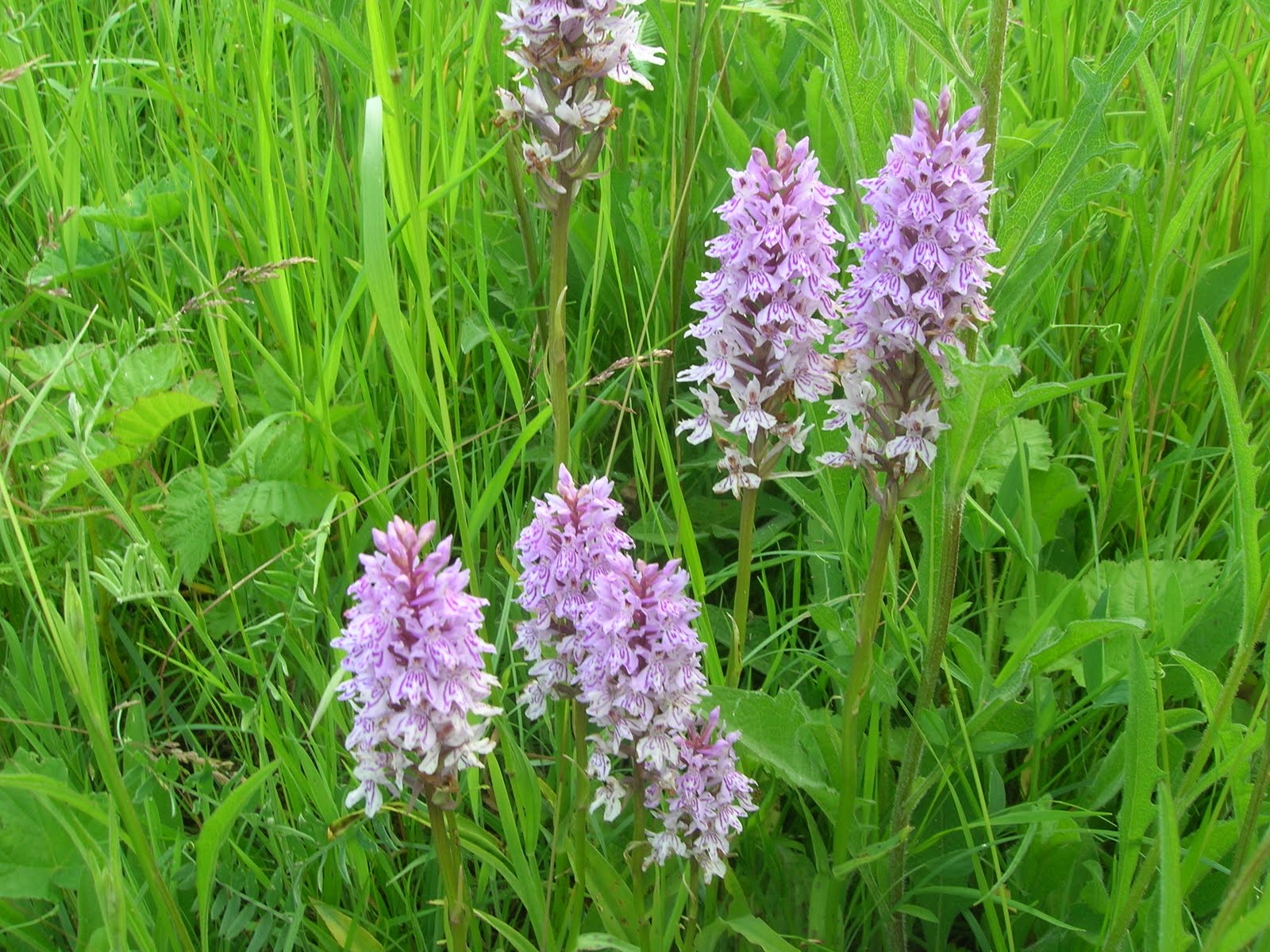
This is a tale about these two plants which have appeared in our garden this year. The orchid appeared last year also but not in the same spot in our front lawn. At times it's not so much a lawn as a nursery for plants that happen to choose to appear!
Earlier this year I cut the grass probably in March or April and kept my eyes open for anything that looked like an interesting plant. Then it was left to grow on until I gave it another cut and this time suddenly spotted a Pyramidal orchid plant just inches in front of the mower! I went round it and left a small path of grass and the orchid to grow on. A bit later as the orchid plant began to send up a flower spike I took a photo and took another just now. The first was on 28th May when the plant was about 19 cm high. You can see that the tips of the leaf has been clipped which I believe was made during the first mowing
The next two were taken today 24th June and the flower is nearly fully open and has grown to 32 cm.
The photos of the Broomrape I'll put in another post!
My personal views on wildlife conservation and the work of the Heart of the Levels Group of the Somerset Wildlife Trust
Search This Blog
Showing posts with label Gardens. Show all posts
Wednesday, June 24, 2015
Sunday, October 12, 2014
Wildlife Gardening in Curry Rivel, Somerset
A contribution to our draft Parish Plan which we hope to publish in draft form in November! Some photos will be added from our Village open garden day
Photo of a Bug Hotel with some rooms occupied! Photo taken in local garden during Somerset Art Week!
Gardeners have a huge role
to play in the future of wildlife as the traditional British
countryside changes. Being more wildlife-friendly doesn't mean you
have to have a messy garden, but it does mean forsaking the ideal of
a perfect lawn and rigidly trimmed borders, but encouraging nature in
gardens can be rewarding and inexpensive.
Feeding the birds with
bought seeds and nuts is popular; less expensive alternatives in the
wildlife garden are flower seed heads, holly berries, walnuts and
apples, attracting birds, wood mice and squirrels. Planting native
hedges is really worthwhile for the shelter and food they provide in
the form of berries, seeds, insects and spiders. Smaller mammals like
wood mice use the base of the hedgerow for shelter, bats need
hedgerows and wood edges for their protection and navigation and
moths love any white or cream coloured flowers like blackthorn in the
hedge.
Attracting bees to the
garden can be achieved by planting flowers such as foxgloves,
honeysuckle, asters, dahlias, geraniums, marigolds and sunflowers.
Clover flowers found in untreated lawns are important for bees, as a
source of both pollen and nectar. Leaving some long grass on the
margins of the garden cuts down on the mowing and the beetles,
caterpillars, butterflies and grasshoppers in the mini jungle will in
turn benefit the birds, bats and hedgehogs.
Many of our most colourful
and well known butterflies depend on nettles for the growth of their
larvae but will also enjoy lavender or buddleia bushes and fallen
fruit.
The hedgehog is very much
the gardener’s friend, feeding on a variety of invertebrates such
as snails and slugs, beetles, caterpillars and worms. A pile of
composted leaves will provide a perfect spot for the hedgehog to
hibernate in a cold winter. A pile of logs or roof tiles is the
perfect refuge for spiders, ladybirds, bees, frogs and slow worms.
Deadwood hedges are a
great way to provide a whole habitat for a large number of animals to
call home, as well as providing a very easy way of getting rid of
branches and waste which are too woody to put on the compost heap.
Other garden waste can be composted to make one of the best soil
improvers you’ll ever have, and certainly the cheapest!
A water feature - even a
simple bowl can encourage frogs and other wildlife which will feed on
bugs and snails. Dragonflies will often breed in them, and many birds
may use them to drink and bathe in.
Thursday, March 07, 2013
Wildlife Gardens and the RHS
One of the best ideas to spread interest in wildlife is this cooperation between the Royal Horticultural Society and the Wildlife Trust called "Wild about Gardens".
Use this link to visit the web site:
http://www.flickr.com/groups/1135104@N24/
Wild About Gardens Newsletter March 2013 | |||||
Now is a good time to do some of those things that will improve the structure or backbone of the garden, like planting trees or making a pond. Both of these will also benefit wildlife hugely, and there are several advantages to getting this work done now.
| |||||
Use this link to visit the web site:
http://www.flickr.com/groups/1135104@N24/
Wednesday, August 29, 2012
Wildlife Friendly Gardening
I've just managed to find all six parts of the RHS series, published in their magazine called The Garden, which they call Living Gardens. Published every month since April 2012. The RHS is part of a group of organisations with a common interest in wild life but covering a wide range of interests. The leading group is Natural England and you can find out more by using the link below.
Natural England - Getting involved
The key words are : getting involved. In Somerset the Wildlife Trust will help you.
Natural England - Getting involved
The key words are : getting involved. In Somerset the Wildlife Trust will help you.
Wildlife Gardening Forum
Natural England is a leading member of the forum, which includes over 150 conservation organisations, agencies, horticultural organisations and media with an interest in wildlife gardening. Individual gardeners are welcome to join too.
Hummingbird Hawk-moth
The forum’s objectives are to:
- Cultivate a responsible attitude to the natural environment among gardeners and the garden industry.
- Gather evidence about the benefits to people and biodiversity of wildlife gardening.
- Pass on information helping people make well-informed choices about their gardening activities.
- Help link people and nature through gardens, to encourage a deeper appreciation of biodiversity and sustainability.
The Forum Manifesto: (2.1mb)
sets out the main issues for wildlife gardening we are tackling. Organisations joining are asked to sign up to the manifesto.
We have produced Bringing your Garden to Life: (5.35mb)
which sets out ten simple gardening practises to make your garden alive with wildlife.
Members of the forum have worked to produce The Big Wildlife Garden
, a fantastic resource for everything you need to know about wildlife gardening and join friends doing it too.
You could help in one of the forum’s working groups. These include research needs, developers and planning, human health and well being, and training and education. The Plants for Bugs Project at RHS Wisley
, is a forum research project looking at the importance of native and non-native garden plants for supporting biodiversity.
We hold conferences and produces newsletters about new findings, case studies and member’s work and events. Visit the how to join page if you would like to be a forum member as an individual or as an organisation. There is no charge to be a member.
Saturday, October 08, 2011
Wildlife Gardening.
The Somerset Wildlife Trust has an active and productive gardening section. Click here to visit their web pages.
With a bit of luck you will also be able to see some relevant photos.
I had this in mind whilst talking to a couple who run a local plant nursery. Note not a garden centre. I liked what I saw and suggested that, locally we in the Wildlife Trust, could cooperate with them in some way to encourage people to make their gardens as wildlife friendly as possible.
They have a web site and a Blog and here are a few quotes from their site.
"We are surrounded by the Somerset Levels, with flora and fauna abundant and no noise or pollution. Just the sound of nature in a relaxed and tranquil setting.
Throughout the Nursery you will find plants that originated from all corners of the world. We owe a great debt to the Plant Hunters who were willing to risk danger and disease so that we could enrich our gardens with colour, fragrance and beauty.
It makes sense to ‘buy local’ and help your environment grow: healthier and cleaner.
We strive to be environmentally friendly, by collecting rainwater from our tunnels to irrigate and mist the plants. We let the birds, insects and amphibians control pests and we carry out good plant husbandry techniques to eliminate diseases."
I hope something can come from this exchange of thoughts on an important subject.
Wednesday, August 17, 2011
Monsters in my new pond
There be monsters about in Somerset.
Just 60 days since we filled our new garden pond with fresh rain water and I've just noticed something stirring in the silt lying on a shelf in the pond. We have only a couple of flowering plants and some floating oxyginating plants some water boatmen and black beetles and not much else. Or so I thought.
Having tried my hand at pond dipping for the first time I managed to collect an odd looking monster, very hairy and quite scary looking for anyone who doesn't like spiders for instance.
So using my friends in the Wildlife Trust and getting the best photo I could manage I have been informed that I have a dragonfly nymph, probably the Broad-bodied Chaser variety.
To back up my discovery here is my photograph.
Just 60 days since we filled our new garden pond with fresh rain water and I've just noticed something stirring in the silt lying on a shelf in the pond. We have only a couple of flowering plants and some floating oxyginating plants some water boatmen and black beetles and not much else. Or so I thought.
Having tried my hand at pond dipping for the first time I managed to collect an odd looking monster, very hairy and quite scary looking for anyone who doesn't like spiders for instance.
So using my friends in the Wildlife Trust and getting the best photo I could manage I have been informed that I have a dragonfly nymph, probably the Broad-bodied Chaser variety.
To back up my discovery here is my photograph.
Thursday, June 16, 2011
Common Blue butterfly
To say this butterfly is common is often only one step away from ignoring it. So this Blog is simply paying a tribute to the evolutionary process which has resulted in a most amazing small insect. The patterning on the under side of its wing is fabulous. This particular specimen happened to come to rest in the late afternoon today on a lavender bush. It wasn't feeding and it just sat there in the late sun whilst I got my camera together . A tripod to minimise hand shake and a 90 mm Macro lens and also a remote button for extra measure. I even had time to experiment with auto, AV and auto macro. The best results with the sharpest and clearest image was definitely using the tripod and macro lens. Click on the picture to see a larger image. Can you tell which one used a 50mm standard lens and which used a macro 90 mm lens and tripod and remote control? Both images are shown with a reduced file size for faster uploading.
Image A
Image B
Image A
Image B
Sunday, February 27, 2011
Just received this notice by email so thought I would pass it on.
Somerset Wildlife Trust
Gardening for Wildlife Group
Garden Plants and Pollinators
Sat March 5th
Avalon Marshes centre Shapwick Road
At 10.00 am there will be a welcome and coffee
At 10.30 am there will be an introduction and overview of the pollination survey. Lead by Penny Richards and Members of the Gardening for wildlife group.
At 11.00 am Paul Keen will guide us on what to look out for with slides.
At 11.30 am we will be working with feed back on the survey, in small groups to discuss the results.
At 12.00 a member of the Invertebrates Group will review key aspects of the invertebrate – friendly garden
We stop for a light LUNCH
Followed at 2.00 pm by a talk by Janet Keeble (Director of Community & Learning SWT)
There will then be an opportunity for a walk on Shapwick Heath for those that want it.
Saturday, May 08, 2010
Wild About Gardens
I've cheated a bit here because these orchids were on a track near a garden. The photos were taken in June 2008 during a walk but they would look good in someones wild garden area!
The notes shown below are taken from the latest newsletter from Wild About Gardens published by the RHS and the Wildlife Trusts to encourage people to encourage wildlife in their gardens. Click here to visit their web site. Or use this address:
http://www.wildaboutgardens.org/
The letter is well worth signing up for to keep up to date on what can be found in gardens.
"On a sunny day in May, it is easy to see why gardens are so important for biodiversity, the variety of life on earth. This is the month when plants race away, outgrowing their allotted spaces, and buds burst into bloom. Into this flourishing and colourful spectacle are drawn many creatures that rely on gardens for shelter, food or water.
This year is particularly important to biodiversity everywhere. It is the International Year of Biodiversity and 22 May is International Biodiversity Day. The aim is to highlight the worldwide decline in biodiversity. This is something that affects all of us, and it is something we can all act on in our own gardens.
Everything you do to help wildlife in the garden makes a difference. More than that, there are some garden species that are known to be in such steep decline that they have special conservation status. Examples include sparrows, starling, bumblebees and hedgehogs. These are species which you as a gardener can help. You can also help where countryside habitats – especially ponds – have declined, by providing substitutes.
What to look out for in May
More butterflies are flying by now. You could see any of: common blue, holly blue, orange tip, painted lady, and the whites – small, large and green-veined. Painted ladies are migrants that come, via Europe, from Morocco. Last year was a bumper year for them and it will be interesting to see what numbers visit us this year.
Look out for slow worms in your compost heap, or sheltering in warm damp places, for example under logs or rocks that have been warmed by the sun. They are active during the day, so there is a chance you may see them as they forage for slugs and snails.
* Swifts are migrants that start to arrive in late April or early May. It is hard to miss the aerial acrobatics and the distant shrieks that fill the air as they swoop and turn after airborne insects. They can be distinguished from swallows, also around now, by the lack of a pale breast and shorter tails. They stay just long enough to breed and return to Africa from late July onwards."
Subscribe to:
Posts (Atom)