Search This Blog

Thursday, January 04, 2007

Carymoor Environmental Centre


It seems a life time ago but back on Dec 8th we went to the Carymoor Environmental Centre near Castle Cary for a Christmas celebration. Good food ,a well stocked bar, live music and chance to meet up with friends from our own group as well as people from the centre and other invited guests made a very pleasant evening. The photos show Peter Keggin and Hamish Craig (see below) and the lively group providing the music.
It was a significant event following on from the merging of the Carymoor Trust with the Wildlife Trust in a way that strengthens both. It gives us a valuable educational and advisory resource within reasonable reach of our area and there will be much of interest to our local members over the coming months. It was fitting that Peter Keggin on behalf of the Somerset Wildlife Trust publicly welcomed the new partnership and thanked Hamish Craig for the work he and the Carrymoor team had undertaken over the 10 years since its formation.

Friday, December 15, 2006

Typical arguments about global warming

From time to time I get into conversation with people who have doubts about what is happening to our climate, usually based on their observations about the weather and what is happening in their garden. To come up with well thought out replies is not easy and so I've looked up such answers on the " How to talk to a Climate Sceptic Guide" blog and as an example I am copying one such answers here. If you wish to visit the blog you can use the link provided on this post or click here:
http://illconsidered.blogspot.com/

This is what you will find as a typical question and answer, using the statement: Climate change is just a natural cycle..

Thursday, February 23, 2006

This is Just a Natural Cycle

(Part of the How to Talk to a Climate Sceptic guide)

Objection:

The current warming is just a natural cycle.

I always find this one a little amusing in the sense that you might as well call it "magic", because natural cycles do in fact have causes. So this is really just trying to insist that the climate science community is as ignorant as whoever it is writing this objection.

Answer:

While it is undoubtedly true that there are some cycles and natural variations in global climate, anyone who wishes to insist that the current warming is purely or even just mostly natural has two challenges. Firstly, they need to identify just what this alleged natural mechanism is because absent a forcing of some sort, there will be no change in global energy balance. So natural or otherwise we should be able to find this mysterious cause. Secondly, a "natural cause" proponent needs to come up with some explanation for how a 30% increase in the second most important Greenhouse Gas does not itself affect the global temperature.

In other words, there is a well developed, internally consistent theory that predicts the effects we are observing, so where is the sceptic model, or theory whereby CO2 does not affect the temperature and where is the evidence of some other natural forcing?

There is a fine historical example of a very dramatic and very regular climate cycle that can be read in the ice core records taken both in Greenland and in the Antarctic. A naive reading of this cycle indicates we should be experiencing a cooling trend now, and indeed we were very gradually cooling over the length of the preindustrial Holocene, something around .5C averaged over 8000 years. It is informative to compare those fluctuations to today's changes. Leaving aside the descents into glaciation, which were much more gradual, the very sudden (geologically speaking) jumps up in temperature every ~100Kyrs actually represent a rate of change roughly ten times slower than the rate we are currently witnessing.

So could the current change be natural? Well, there is no identified natural cause (and they have been looked for), there is no theory of climate where CO2 does not drive the temperature and the natural cycle precedents do not show the same extreme reaction we are now witnessing.

(That would be a "No")


Other Guides, by Category

posted by coby @ 2/23/2006 01:07:00 PM

Thursday, December 14, 2006

Nature Reserve comments


The photo shows the peaceful scene as the upper reaches of the River Cary cross a farm track alongside the Babcary Reserve. A second photo shows the information board for the reserve which as noted below you can only see after finding your way down the lane to the ford. The entrance to the reserve is just before the river.

Three members have sent me comments partly in response to the questionaire on reserves , the subject of an earlier post, which I think are probably representative of the experience of members.

The first reflects the situation for many people who are not used to spending time in woods these days espcially if they live in an urban area. The Trust magazine by coincidence has a feature on urban wildlife!


I think the general public like being nannied, they like carparks,
information boards with map of the site ,defined paths and boundaries. They
are afraid of going off paths in case its not allowed or they might damage
something. I'm aware that we as a family don't get out enough and am intending
dragging the kids to some of the trusts reserves in the coming months. I
think organised events like the fungi hunt at Aller do encourage people to
return on their own. We were intending to get to the fungi hunt but
something else took priority, maybe get there next year.


The second I suggest links the need for people to become aware of the connection between the survival of wildlife and damage to the woods and fields,caused by human activity e.g. pollution.

On climate change, an important message to get over is the individual responsibility of us all. What can I do or change? Rather than/as well as ideas and policies. In answer to that today , I am helping to explore a Greenfest in June 07 in Taunton. In the light of Gordon Browns speech, find out what SCC is doing to adress the need to monitor/regulate energy use in our schools.


I've added some photos of Orchids in Great Breach Wood taken last year and an information board for two small reserves conected to it i.e. all on the same site.


As I have posted before I use The Great Breach Wood a lot as a place to walk and enjoy at all seasons of the year. Access to this, if you dont know how to get there, presents some problems. Particularly for access by car which unless you cycle is the only practical access.


The reserve its self is some way from a road 1/4 to 1/2 mile walk in the middle of a larger wooded area.
The reserve is signposted when you get into the part of the larger woodland where the reserve is located, but from the initial access points there are no indications where the reserve is.
Pathways are mown in the reserve in the autumn and judging purely from the degree that these become muddy and apparently used quite a lot, people find the reserve. Though it must be said that one doesnt often meet up with other visitors.
The other reserves that are near to me, Green Down and Babcary Meadows have similar access issues. Unless you are aware of their existance, finding them is not easy as there is no signposting for the reserve untill you are on the boarders. In the case of both these reserves, while the signposts for the pathways that you need to travel over are in place (South Somerset District Council are to be commended). There is no linkage between these and the Trust's reserves.

Monday, December 11, 2006

Attention to human rights is needed in tackling climate change

This report is on the BBC web site and seems to me to show a significant change in attitude to global climate change. The following is an extract from the news report.


Last Updated: Monday, 11 December 2006, 01:58 GMT

Rights focus sought over climate

Poor nations are said to be most at threat from climate change

More attention to human rights is needed in tackling climate change, former Irish President Mary Robinson will say in a lecture.

Her speech at Chatham House, a think-tank in London, will argue that climate change is now an issue of global injustice.

The ex-UN high commissioner for human rights will urge policymakers to adopt "a radically different approach".

She will also urge rich nations to meet their climate change obligations.

"We can no longer think of climate change as an issue where we the rich give charity to the poor to help them cope," she is expected to say.

"Climate change has already begun to affect the fulfilment of human rights and our shared human rights framework entitles and empowers developing countries and impoverished communities to claim protection of these rights."

Ms Robinson will argue for the revival of multilateral efforts that led to the global eradication of smallpox and the phasing out of CFC gases.

Friday, December 08, 2006

Change of format for blog in process

It may take a few days to sort out the layout for this blog now that I've changed to what they call the Beta Blogger . It should be possible eventually to improve the appearance and the ease of use for visitors.


With reports of tornados and floods and colder weather to come here in the UK I am including a photograph taken from the house of a friend living in South Africa. It looks a good place to be!


And here is a wild flower seen on a walking holiday last year in Croatia


Finally a typical meadow flower popular with butterflies in the summer just to cheer us all up. (greater knapweed)

Monday, December 04, 2006

Nature reserves

The Somerset Wildlife Trust recently asked members to complete a questionnair on the subject of: "Access to the Natural Environment for All, Prioritising Reserves for Improved Access."

I thought it might show something of the behind the scenes activity by the Trust to share my response on this blog. My comments,shown below, reflect the fact that we, as a new conservation group, have limited experience of the Trusts reserves but we are learning.

Here are some of the questions.

How many visitors use your reserves?
How are reserves used currently?
What are the main age groups of visitors?
What are the main benefits to the public of reserves?
What if any are the barriers to people visiting the reserves?
Are there any disadvantages of the public visiting the reserves?
Are there other users of the countryside that have caused problems in the past?


"My comments on the reserves are limited because neither I nor most of our committee have much awareness of our reserves. That's not very good I know but now we have the Heart of the Levels Group we are conscious that we need to rectify the situation. Last summer I tried to find out where our nearest reserves were and at least find the locations from the grid references. No small task I found.
You sent me four sheets. Aller and Beer Woods, Westhay Moor, Catcott Heath, Catcott Lows.
I have been to the first two, on two or three visits only.
I have no info on how many people visit the reserves.
I can only make general comments on the benefits of reserves and possible barriers to visits.
I also will attach my listing of reserves that are either in our area or nearby which includes the last three above. There are 20 reserves listed.
All the Westhay areas are out of our local area in any event. Beer and Aller Woods is probably our largest , most accessible and scenic local reserve. The list includes info I have been given about managers which I know is out of date now as David Reid has retired.
I have taken the opportunity of checking through the new booklet and comment on the entries there.

The booklet is very neat, handy size and well produced.
It took a little while to work out the way to use it though. I started by looking at the map, finding a reserve and noted the ref number.
I eventually realised that the ref number is not the page number and you need to go to the contents page which provides the page number but not the reserve ref number. Once I'd got that straight it is fine.Perhaps the contents page could say at the top left, page number and have on the right Reserve Map Ref Number.
I find the location map very useful but now it doesn't show the "other " reserves. Some of the others are our best sites i.e. Babcary Meadows and Dundon Beacon.
The individual maps are the same as for the old booklet. As I tried to find our reserves I found the maps too restricted in area and references to local roads. Hence it took a little effort to find them from grid references and the diagrams and to tie them down on OS maps.
Some don't have notice boards i.e.Fivehead Arable fields.
Despite the references to cycle and foot access many people will approach them by car and car parking arrangements are a bit limited in most cases so people really need to be forewarned with best, nearest, places to park. In some cases this is given.
Some reserves don't have diagrams at all, e.g. Beer and Aller Wood, Green Down.
I appreciate that it seems the intention to concentrate on a limited number of reserves which covers 8 of my list of 20. We could also include West Sedgemoor RSPB site and no doubt others. Then there are private reserves which we may try to identify and seek permission for visits.
Even with the new book I think we might be able to add detail for our local members to make it easier for them to get out to the reserves. Perhaps we will end up concentrating on a few.
If you ask me again in 12 months time I hope to be better informed.

What do we members get out of reserves?
The Westhay starlings display is out of this world on a good day! It really makes you realise how amazing the natural world is and its on our doorstep.
Seeing the herons nesting at West Sedgemoor is impressive.
Going on a fungus foray in Aller and Beer Woods in remarkable and fascinating.
"Clouds" of butterflies in a wild flower meadow can be quite startling for its unexpected beauty.
Places like Westhay even on a quiet day are so peaceful and natural with occasional sighting of birds getting on with their lives.
I must get to Green Down next summer on one of the visits to see the Large Blue butterfly.

What are the barriers?
All the points I mention above might help to reduce barriers.
Area Groups and Reserve Managers could perhaps cooperate more to get members to visit. Once they have had an escorted tour they will be much more likely to visit on their own initiative. This is our aim as far as possible.
It should help to be better informed about climate change issues and farming methods and management of the countryside.
I think Carymoor should be useful for us locally as an educational resource and I hope to visit soon. ( Dec 8th in fact).
School visits arranged by Area Groups might help.
As much information as possible about the best times to visit and what to look for must be important."

Monday, November 20, 2006

Stop the Chaos rally


press releases: Climate Chaos: Hottest Issue, Coolest Event of the Year

PRESS RELEASE

STOP CLIMATE CHAOS: 25,000 gather in Trafalgar Square, London
‘I Count’ event: Saturday 4th November, Trafalgar Square


More than 25,000 people packed Trafalgar Square and closed surrounding roads today to make their voices count, each one calling for urgent action on climate change.

The carnival-like event was the first of its sort for ‘I Count’ - an unprecedented and rapidly growing public campaign which brings together a huge range of supporters from the Women’s Institute members to Razorlight.

Tens of thousands of ‘I Count’ supporters travelled from across the UK, some by bike, canoe, on foot and even in biofuel green taxis to highlight what many believe to be the greatest man-made threat ever. Surfers Against Sewage arrived wearing wetsuits and carrying surf boards.

The I Count Campaign calls on the UK government to provide:-
• Action internationally: ensure that global greenhouse gas emissions are irreversibly declining by 2015.
• Action for justice: deliver assistance to developing countries to adapt to climate change and give access to clean energy to meet their developmental needs.
• Action in the UK: introduce a Climate Bill to reduce greenhouse gas emissions by at least 3% per year.

Sunday, November 19, 2006

Shopping over the internet can raise money for the Trust

I've been checking out the Trusts shopping link and because it seems a good idea here is some information to help you look for yourself.
Shopping over the internet is growing in popularity and if you wish to let the Trust benefit all you need to do is to start from the Trusts web page as shown below.


Click here to go to their web site. http://www.somersetwildlife.org/


Many of the big names can be accessed from this web site. By using this link from the Trusts web site the retailer automatically registers your purchase and makes a small contribution to the Trust. If all internet shoppers in Somerset used this device it would add hundreds of pounds to the Trusts finances. Look for the "Buy At" link.

Help raise funds for our vital conservation work by shopping on the internet.

Click here to visit 'Buy At', where you can purchase gifts from retailers including Marks and Spencer, John Lewis and Amazon and earn the Trust commission at the same time. And don't leave without visiting our shop where you can 'Adopt a Dormouse'

http://www.buy.at/somersetwildlife

Saturday, November 18, 2006

Climate Change news

A feature of producing a blog is that it reflects the interests of the blogger. What I am finding interesting is the wide ranging views and debates in progress around the world on global warming and climate change. Here are some brief reviews of two of today's news stories.

As you may know a world conference on this subject has just ended in Nairobi. Run by the United Nations and called the UN Framework Convention on Climate Change. ( UNFCCC) This particular meeting is called the COP12. That is short hand for the 12th Conference of the 189 parties(countries) to the UNFCCC. To no doubt save aviation fuel it is also the COP/MOP2. That is the 2nd meeting of the 166 parties to the Kyoto Protocol. This complex organizational nightmare was of course all started back in 1992 at the Rio Earth Summit.

Here is an extract from a BBC report shown on their web site at http://news.bbc.co.uk/1/hi/sci/tech/6161998.stm


Last Updated: Saturday, 18 November 2006, 18:42 GMT
Climate talks a tricky business
By Richard Black
Environment correspondent, BBC News website, Nairobi

"Busting the jargon

So let us look behind the jargon of COPs and COP/MOPs and SBSTAs and Ad-hoc Working Groups and Joint Implementation and Base Years - believe me, I could go on - and look at what the Nairobi talks actually agreed.

The headline outcomes include:

* a less than firm commitment to begin negotiations on further Kyoto Protocol emissions cuts in 2008, and no target date for concluding them - despite an acknowledgement that emissions need to fall by about 50% in the near future

* a decision that the protocol has been reviewed at this meeting, as its original wording demanded - many of us must have missed the review when we blinked

* a commitment to have a full review in two years' time

* an extension of work on technology transfer to the developing world, but only for a single year, which brought condemnation from the Chinese delegation

* agreement that Belarus can enter the Kyoto Protocol's trading mechanisms in a way which could allow it to make money without reducing emissions; this decision will have to be ratified

* a decision that carbon capture and storage (CCS) projects should not yet be eligible for money from the Protocol's Clean Development Mechanism

* agreement that the Adaptation Fund, a pot of money to help developing countries adapt to the impacts of climate change, should be primarily under the control of developing nations

Away from the main negotiations, a number of other initiatives were announced, the most striking being a UN fund to build capacity among African governments, enabling them better to bid for clean technology projects and protect against climate impacts."

********************************************************************************

Meanwhile the Independent newspaper has published an interview with Tony Blair in which he defends his governments progress in green issues. Here are some extracts from the article.

Blair: Who says I'm not green?
by Michael McCarthy, Environmental Editor
Published: 18 November 2006 Here is the web site address.

"Britain is seeking international agreement on a global target for stabilization of greenhouse gases, which would halt the progress of global warming, Tony Blair has told The Independent."

"The target Mr Blair and his officials have in mind would seek to halt the growth of greenhouse gases somewhere below 550ppm CO2e, perhaps between 500 and 550 - the figures are still being discussed, but 550 is regarded as the upper limit.
It would involve legally binding cutback agreements from those who signed up to it, and has been put forward by the UK to be taken on during the German presidency of the G8 next spring. The initiative - which has German support - would offer a major way forward for when Kyoto comes to an end in 2012."

"He also implicitly ruled out aviation taxes, another measure favoured by the green lobby, insisting that a much better way forward was to deal with aircraft emissions under the European Union's emissions trading scheme."

""I've given my view that if we want to deal with energy security and climate change, we've got to have the right policy for the future, and it's got to include nuclear.""

"Mr Blair also revealed that Britain would seek agreements to make future EU coal-fired power stations carbon neutral through improved technology."

"And he hinted that a planned Energy White Paper would address the issue of personal carbon allowances - the idea that each individual would have a carbon "budget" to spend on motor fuel, electricity and other activities that impact on the environment."

Thursday, November 16, 2006

A talk about the facinating life of Dragonflies


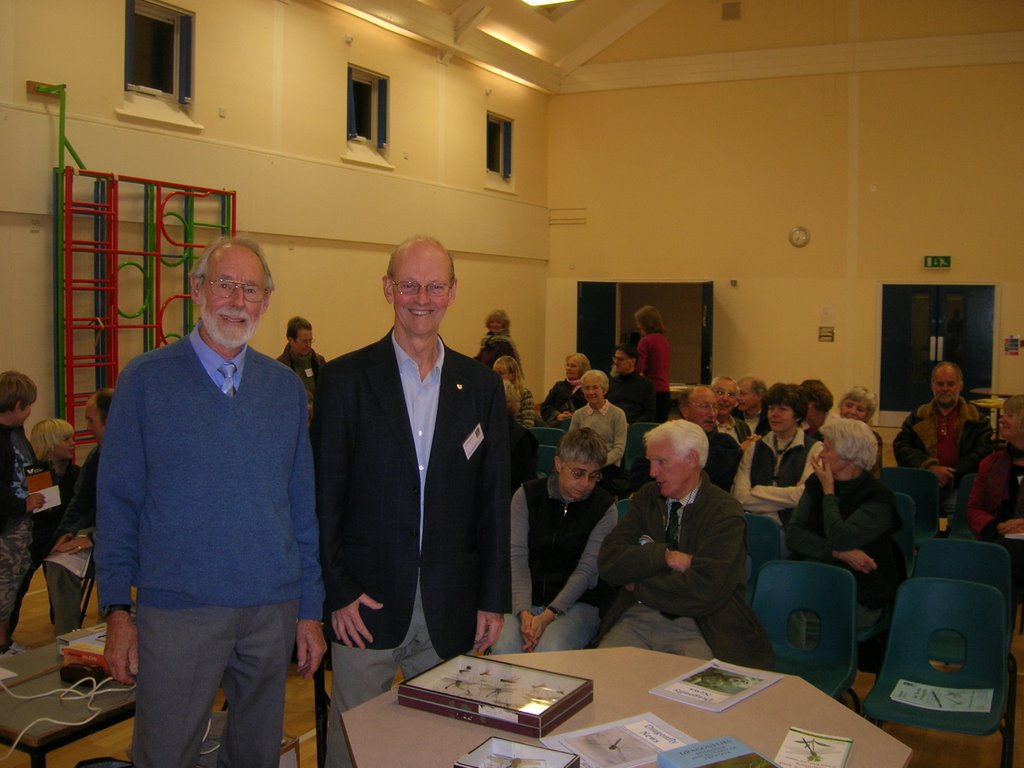
Dr Mike Parr a local member of the Trust talked about his experiences in the UK and Africa whilst studying dragonflies. His often amusing accounts of the habits of these remakable creatures left us wanting to know more. Above is a photograph showing Dr Parr and our blog editor before the meeting started. Below is our press note sent to our local paper and we look forward to its publication.

"Members of a new wildlife group for the Langport, Somerton and Curry Rivel area became so engrossed in the topic of dragonflies at their latest meeting, they decided to go on a field trip to study the creatures in the summer.

Expert Dr Mike Parr told the Heart of the Levels group that the biggest threat to dragonflies and damselflies is habitat loss, followed by pollution, drainage, and road vehicles which kill “a lot”. But the Somerset Levels are a hotbed for certain types of these insects, he said.

So many people asked questions about the water-loving creatures – which predate the dinosaurs by “a long way” – that Dr Parr, who has spent much of his career studying the insects, offered to organise a field trip for members next July, a suggestion readily taken up by the meeting, in Curry Rivel."